
Vitorchiano, one stone and two horizons.
Peperino connects the houses of a Tuscia town with a Moai made there in 1990. The interesting journey is between those two stories, rather than through a claim to a world record.
2026-11-09 · SOURCED DISCOVERY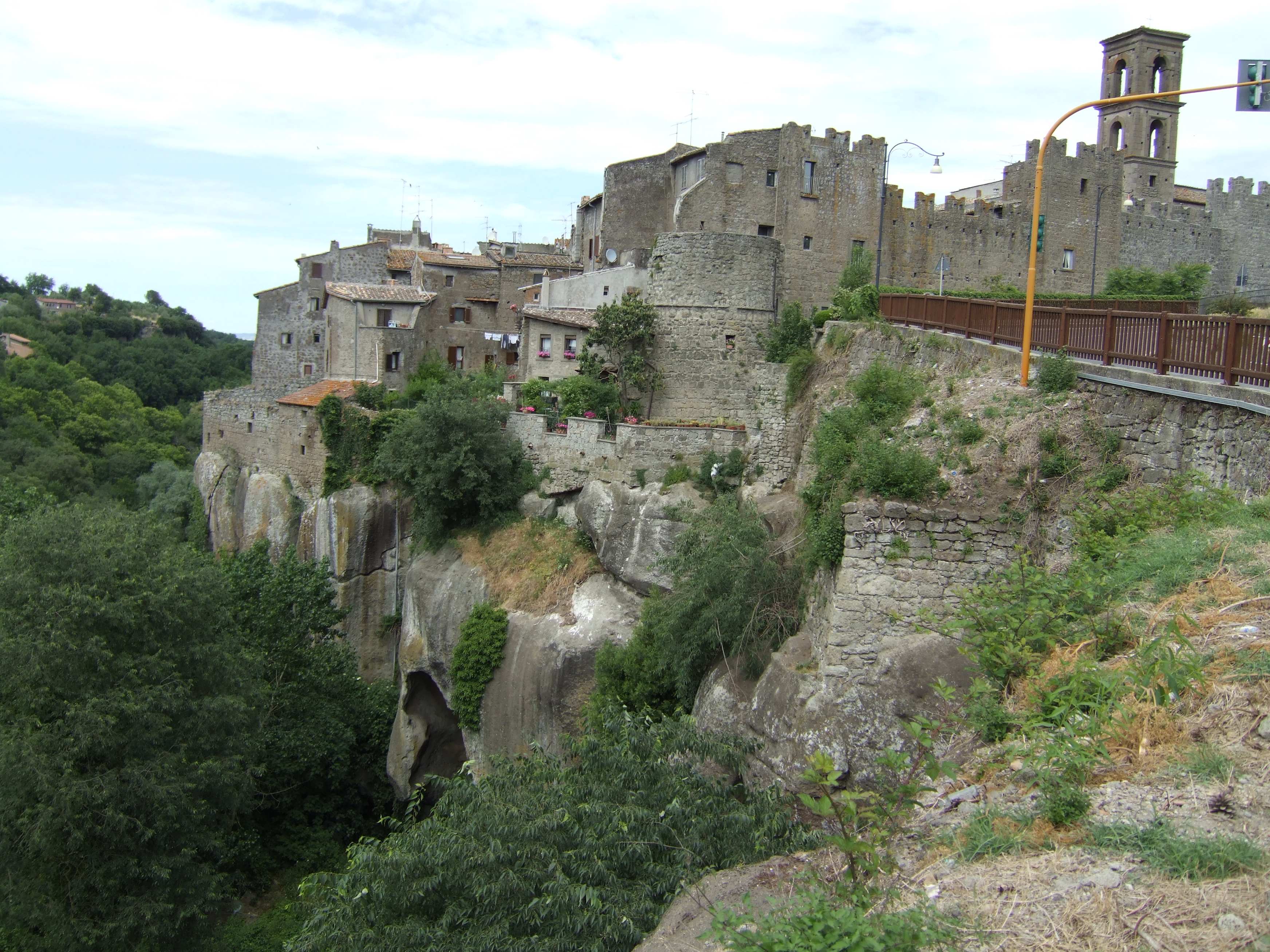
At Vitorchiano, the architectural subject is the relationship between a settlement and its rock. VisitLazio describes a medieval town in the Tuscia whose dark-grey peperino buildings continue the colour of the spur beneath them. Its account draws attention to the profferli: external stairs ending in a small loggia before a house entrance. These are useful details for a visitor to follow, because they bring the eye from a distant skyline back to the scale of a doorway.
A photograph can compress that relationship into a single image, but a useful visit need not do the same. Consider allowing separate time for looking at the settlement from outside and walking through its streets. One view helps explain the overall form; the other makes room for individual buildings and the transitions between public space and private entrances. This is our suggested way of approaching a residential place, rather than a description of a route we have tested or an invitation to enter houses.
The local tourism website locates a second encounter at Largo Padre Ettore Salimbeni, beside the municipal camper area. Its account dates the peperino Moai to 1990 and attributes its creation to the Atan family from Rapa Nui. The sculpture was made locally, as part of a television-linked project associated with the conservation of the Easter Island monuments. That is a modern cultural connection, not evidence of an ancient Polynesian presence in Lazio.
The two subjects make an interesting pairing because the material stays local while the reference changes. In the houses, peperino helps a visitor read the built setting; in the sculpture, it becomes a means of exchange with a distant culture. The attraction does not depend on proving a global superlative. Nor does it require reducing the town to an unusual object placed beside it. A more rewarding question is how people have put the same material to different purposes, and what each use asks us to notice.
For a visit, keep the historical centre and the sculpture as distinct stops and check current access and transport with the municipality. A dramatic photograph is not an accessibility assessment: anyone for whom gradients, steps or walking distances matter should ask for a suitable route before travelling. The sources consulted here do not establish a step-free itinerary, current parking arrangements or opening hours for individual buildings. These details belong in the practical planning, rather than being inferred from the destination’s appearance.
Vitorchiano belongs in a Tuscia itinerary for the conversation between ordinary buildings, local stone and an unexpected cultural reference. This selection is based on published tourism information, not an editorial stay or visit. The opening image is an archive photograph of the town taken in May 2009; it shows the settlement, not the Moai and not present-day conditions. The stone gives the story continuity, while the date keeps the photograph honest.
Before you go.
- Location: Vitorchiano, province of Viterbo, Lazio.
- The local tourism site places the Moai at Largo Padre Ettore Salimbeni, beside the municipal camper area.
- Check current travel, parking and accessibility details directly with the municipality.
- Archive opening photograph: 30 May 2009.
Sources & verification.
- VisitLazio — Vitorchiano: architecture and local stone ↗ · Checked 2026-11-09
- Visit Vitorchiano, municipal tourism website — Il Moai di Vitorchiano ↗ · Checked 2026-11-09
- Wikimedia Commons — K.Weise photograph, 30 May 2009, public-domain dedication ↗ · Checked 2026-11-09
Independent desk research for The Guest Journal, checked on 9 November 2026. This is not a report of a visit, hosted stay, booking or independently tested visitor route. Confirm current access and travel arrangements directly.